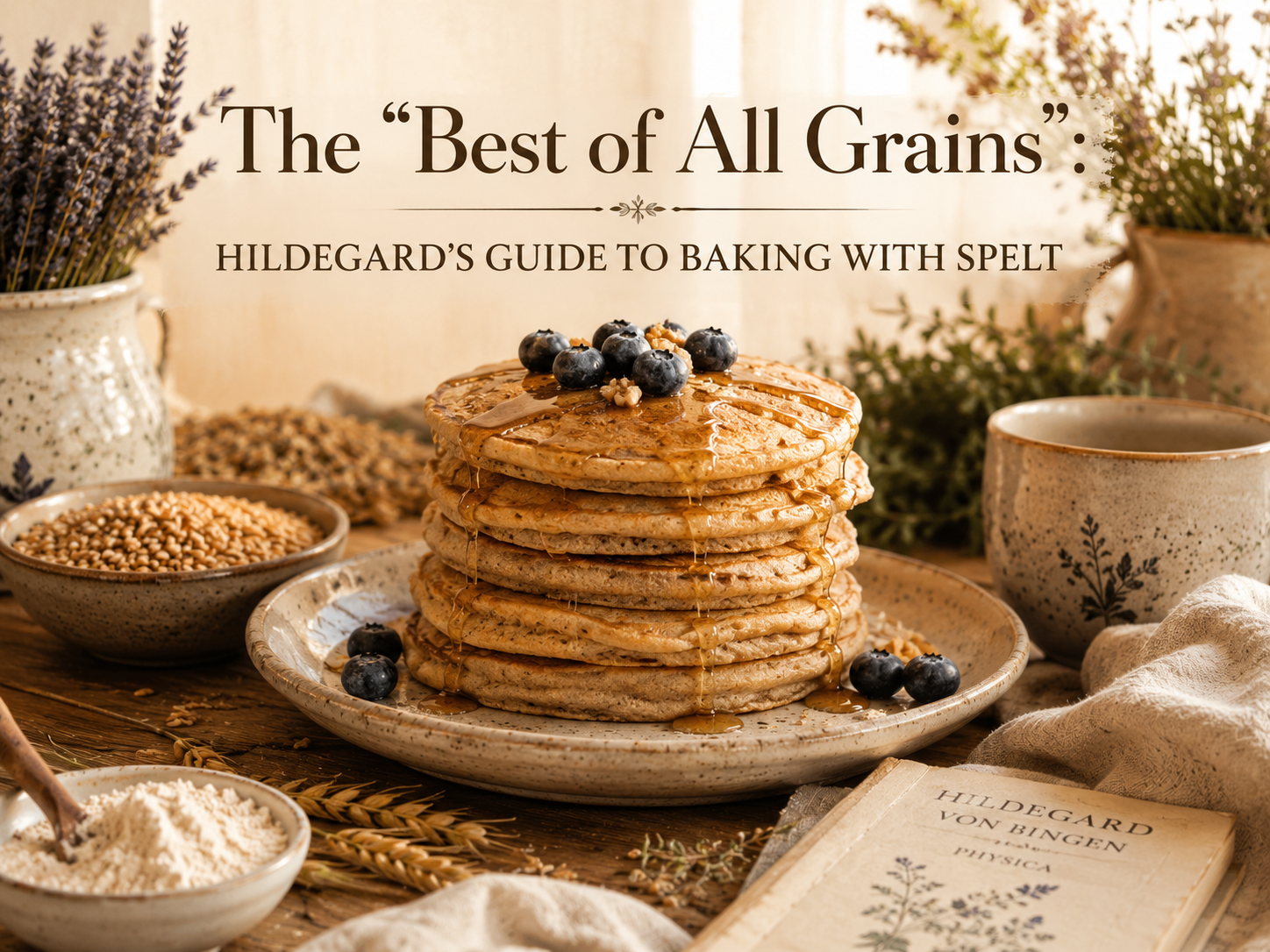
Discover how to bake nourishing spelt bread with Hildegard von Bingen’s ancient wisdom. Beginner-friendly recipe, tips, and the healing power of this beautiful grain.
| ✦ ToYourBliss.com ✦Creating with intention, building with heart. |
A Loaf That Carries Centuries of Wisdom
Have you ever stood in the kitchen, flour on your hands, and felt like you were doing something quietly sacred? That’s exactly how I feel every time I bake with spelt.
I came across Hildegard von Bingen almost by accident — reading about medieval herbalism — and her words stopped me mid-scroll. This 12th-century Benedictine abbess, mystic, composer, and healer called spelt “the best of all grains,” praising it as warming, nourishing, and a source of joyful spirit. Nearly 900 years later, I was pulling a golden spelt bread loaf from my oven thinking: she was onto something. Baking with spelt flour is one of the most satisfying, grounding acts of intentional living I’ve found in my kitchen. And by the end of this post, you’ll know exactly how to do it — whether you’re a total beginner or someone looking to swap out modern wheat for something more ancient and alive.
Why Spelt Bread Belongs in Your Intentional Kitchen

There’s a reason the ancient wisdom revival is happening right now. We’re surrounded by processed, hybridized, hurried food — and our bodies and spirits are quietly asking for something more real. Baking spelt bread from scratch is the antidote.
Hildegard didn’t separate food from medicine or nourishment from joy. She believed spelt makes right flesh and right blood, gives a happy mind and joy in the spirit. Modern nutrition backs a lot of this up — spelt is higher in protein than wheat, rich in B vitamins, magnesium, iron, and zinc, and its gluten structure is gentler and more water-soluble, meaning it’s easier for many people to digest. But beyond the nutrients, there is something deeply cozy and curated about pulling a hand-shaped loaf from a hot oven. It’s mindful making in its purest form. It’s nourishment for the body and the soul.
Shop the Look — Everything I Reach for When I Bake Spelt Bread
Here’s everything I’d gather before starting this project. These are the things I actually use and love — nothing fussy, nothing unnecessary.
- Bob’s Red Mill Organic Spelt Flour, 20oz — My go-to, and I’ve tried several. Bob’s Red Mill stone-grinds their organic spelt on century-old millstones, preserving the natural oils and nutrients. The flavor is genuinely nutty and sweet in a way that makes you want to eat the whole loaf warm with butter. The real deal.
- Bob’s Red Mill Spelt Flour, 22oz — Another good alternative.
- Shiloh Farms Organic Spelt Flakes, 16 oz — Perfect for morning breakfast!
- USA Pan Nonstick Standard Bread Loaf Pan — I’ve had mine for years and it hasn’t warped once. The corrugated surface improves airflow for a perfectly even bake, and the nonstick coating means spelt loaves release beautifully every time. Made in the USA and PFOA-free.
- Lodge Seasoned Cast Iron Loaf Pan — If you want that deep, dark, rustic crust like it came from a European bakery, cast iron is the way. It holds heat incredibly well and gives spelt bread that gorgeous thick bottom crust.
- Cast Iron Dutch Oven – Also, excellent for baking breads.
- Bob’s Red Mill Active Dry Yeast — Reliable, consistent, and pairs perfectly with spelt flour. No surprises, no sad flat loaves. Keep a jar in the fridge and it stays fresh for months.
- Redmond Real Salt — Fine Ancient Sea Salt — Salt matters more in bread than people realize. This mineral-rich ancient sea salt brings out spelt’s natural sweetness without any sharpness. The kind of ingredient that quietly elevates everything.
- Linen Dish Towels for Bread Proofing — Hildegard would absolutely approve. A good linen cloth lets your dough breathe during its rise and keeps the surface from drying out. Beautiful, functional, and feel like an heirloom in the making.
How to Bake Spelt Bread: A Beginner-Friendly Guide
1. Understanding Spelt Flour Before You Begin
The single most important thing to know about spelt flour is that it behaves differently from wheat flour — and once you understand why, everything clicks.
Spelt’s gluten is more water-soluble and more extensible than modern wheat. This means the dough is stretchier, relaxes quickly, and can become over-worked if you’re used to kneading bread dough aggressively. The good news? This actually makes spelt more forgiving for beginners in many ways. Less kneading. Simpler handling. A gentler pace.
Spelt also absorbs water differently — it requires slightly less than whole wheat flour, so if you’re adapting a favorite wheat recipe, reduce your liquid by about 10–15% and watch how the dough responds. Start with a soft, slightly tacky dough. It shouldn’t feel tight or dry.
| ✨ Thoughtful Tip: Whole grain spelt flour will give you a heartier, denser loaf with more earthy flavor — this is what Hildegard would have used. White spelt produces a lighter, airier crumb. I love blending both: about 70% white spelt and 30% whole grain for the best of both worlds. |

2. Hildegard-Inspired Homemade Spelt Bread
Makes: 1 large loaf
Ingredients
- 4 cups whole spelt flour
- 1¼ cups warm water (about 105–110°F / 40–43°C)
- 2¼ teaspoons active dry yeast (1 packet)
- 1 tablespoon raw honey
- 1 teaspoon fine sea salt
- 2 tablespoons olive oil
- Optional: 1 teaspoon ground fennel seeds (a favorite Hildegard herb for digestion)
Instructions
- Activate the Yeast
- In a large bowl, combine warm water, honey, and yeast.
- Let sit for 5–10 minutes until foamy.
- Mix the Dough
- Stir in olive oil and salt.
- Add the spelt flour gradually, mixing until a soft dough forms.
- If using fennel, add it with the flour.
- Knead
- Turn the dough onto a lightly floured surface.
- Knead gently for 5–7 minutes. Spelt develops gluten more quickly than wheat, so avoid over-kneading.
- First Rise
- Place dough in a lightly oiled bowl.
- Cover with a clean towel.
- Let rise in a warm place for about 60–90 minutes, or until nearly doubled.
- Shape the Loaf
- Gently shape into a round or oval loaf.
- Place on a parchment-lined baking sheet or in a loaf pan.
- Second Rise
- Cover and let rise another 30–45 minutes.
- Bake
- Preheat oven to 375°F (190°C).
- Score the top with a sharp knife.
- Bake for 30–35 minutes until golden brown and hollow-sounding when tapped.
- Cool
- Allow the bread to cool completely on a wire rack before slicing.
Hildegard’s Traditional Serving Suggestions
Serve with:
- Fresh butter
- Soft cheese
- Herbal honey
- Homemade vegetable soup
- A cup of warm fennel tea
3. The Classic Hildegard-Inspired Spelt Loaf (Smaller Batch)
This is the recipe I come back to again and again — simple enough for a Tuesday evening, special enough to wrap in linen and gift to a friend.
You’ll need:
- 3 cups white spelt flour (or a blend with whole grain)
- 1 teaspoon active dry yeast
- 1 teaspoon fine sea salt
- 1 cup warm water (about 105°F — warm to the wrist, not hot)
- 1 tablespoon olive oil (optional, adds moisture and gentle richness)
The method:
Dissolve your yeast in the warm water and let it sit for 5 minutes until foamy and alive. In a large bowl, whisk together the flour and salt. Add the yeast mixture and stir until a shaggy dough comes together. Knead gently on a lightly floured surface — about 5 minutes, not the aggressive 10-minute workout you might be used to with wheat bread. The dough should feel smooth, soft, and just slightly tacky. Shape into a ball, place in a lightly oiled bowl, cover with a linen cloth, and let rise in a warm spot for 60–90 minutes until roughly doubled.
Punch down gently, shape into a loaf, and place in your prepared pan. Let it rise again for 30–45 minutes. Bake at 400°F for 35–40 minutes until the crust is deep golden and the loaf sounds hollow when tapped on the bottom. Cool on a rack for at least 20 minutes before slicing — this is the hardest part.
| Thoughtful Tip: Give the loaf a light spray of water right before it goes into the oven. This creates a small burst of steam in those first minutes of baking, which helps the crust develop that gorgeous crackly exterior. A trick bakers have used for centuries. |
4. Going Sourdough — Spelt’s Most Ancient Form
If you have a sourdough starter (or want to make one — spelt gets a starter active incredibly quickly), spelt sourdough is one of the most nourishing and digestible breads you can bake. The long fermentation process breaks down phytates, the compounds in grains that can interfere with mineral absorption. Hildegard intuitively recommended slow-risen breads, and modern food science has confirmed exactly why that matters.
For a basic spelt sourdough, use 100g of active starter, 450g of white spelt flour, 300g of water, and 10g of sea salt. Mix, let it ferment at room temperature for 4–6 hours with gentle stretch-and-folds every 30 minutes for the first two hours, then shape, place in a floured banneton, and cold-ferment in the refrigerator overnight. Bake the next morning in a preheated Dutch oven at 450°F — 20 minutes covered, then 20–25 minutes uncovered for a beautiful open crust.
| Thoughtful Tip: Because spelt is so extensible, your sourdough dough may feel quite loose and slack compared to wheat-based sourdoughs. Resist the urge to add more flour. That extensibility is what gives spelt sourdough its beautiful, slightly open crumb. |
5. Simple Additions That Honor Hildegard’s Traditions
Once you’re comfortable with the basic loaf, Hildegard’s writings offer beautiful inspiration for add-ins. She wrote extensively about herbs and spices as medicine and food, and folding some of these into your spelt bread elevates it from nourishing to truly sacred.
- Galangal: Known in Hildegard’s medicine as a warming, protective spice, galangal adds an extraordinary depth to spelt bread. Start with just ½ teaspoon in the dough.
- Fennel seeds: Hildegard loved fennel for digestion and joy. A tablespoon kneaded into the dough creates a subtly fragrant, slightly anise-kissed bread that pairs beautifully with hard cheeses.
- Walnuts and honey: A handful of roughly chopped walnuts and a drizzle of raw honey makes a loaf that feels like it belongs on a medieval abbey table — in the best possible way.
- Fresh rosemary: Strip two sprigs, chop finely, and fold into the dough after the first knead. It sings with spelt’s nutty sweetness.

DOs & Don’ts — Spelt Bread Edition
| ✅ DO This | ❌ Don’t Do That |
| Use a kitchen scale if you can — measuring by weight gives far more consistent results with spelt. Cup measurements vary too much. | Substitute spelt flour 1:1 in wheat recipes without adjusting liquid. Reduce water by about 10–15% to account for spelt’s higher water-solubility. |
| Under-knead rather than over-knead. Spelt’s gluten degrades with too much working. When in doubt, stop. | Use water that’s too hot for the yeast. Above 115°F you’ll kill it and end up with a flat, sad brick. Warm to the wrist is the old baker’s test. |
| Let the bread cool completely before slicing. The interior is still finishing as it cools. Cutting too early gives you a gummy crumb. | Skip the second rise. That 30-minute rest after shaping is when the loaf develops its final structure and flavor. Rushing it gives you a dense crumb. |
| Store in a linen cloth or paper bag at room temperature. Spelt keeps well for 2–3 days this way. | Store it in the refrigerator. The cold actually accelerates staling in bread. Freeze for longer storage instead. |
| Try the sourdough version. It takes more patience, but the digestibility and flavor are genuinely on another level. | Expect it to taste like sandwich bread. Spelt has its own flavor — nutty, slightly sweet, earthy. That’s not a flaw. That’s the whole point. |
Troubleshooting Your Spelt Bread
Question: My dough is incredibly sticky and hard to work with. What am I doing wrong?
Spelt dough should be softer and more tacky than wheat dough — this is normal. Resist adding extra flour, which makes the bread dense. Instead, lightly oil your hands and work surface. If it’s genuinely unworkable, you may have too much water; reduce by 2 tablespoons next time.
Question: My loaf didn’t rise much. Is the yeast dead?
Possibly. Always proof your yeast first: dissolve it in warm water and wait 5–10 minutes. If it doesn’t foam and smell yeasty, start fresh. Yeast past its date or stored poorly loses potency.
Question: The crust is beautiful but the inside is gummy.
Almost always a sign the bread needs more oven time, or was sliced while still warm. Try an internal temperature test: spelt bread is done when the center reaches 200–205°F on an instant-read thermometer.
Question: My spelt sourdough spread out flat instead of rising up.
This is called over-proofing or poor shaping. Spelt sourdough is particularly sensitive to timing. Use a well-scored top (the slash helps the bread expand upward rather than outward) and make sure your shaping creates real surface tension on the loaf.
Question: Can people with wheat allergies eat spelt bread?
Spelt contains gluten and is not safe for those with celiac disease. However, many people with non-celiac wheat sensitivity find spelt much easier to tolerate, especially in sourdough form, due to its different gluten structure and lower phytate content. Always consult a healthcare provider if you have a medical condition.
Customization & Variations
For the minimalist: The simplest possible spelt bread — just flour, water, salt, and yeast — is also the most beautiful. There’s a Cistercian elegance to it. Don’t feel like you need to add anything. The grain itself is the story.
For the kitchen herbalist: Fold in 1 tablespoon of dried fennel seeds, ½ teaspoon of galangal powder, and a pinch of nutmeg — a direct nod to Hildegard’s own spice cabinet. It makes an extraordinary bread for cheese boards and winter soups.
For those on a budget: White spelt flour is more economical, bakes lighter, and is easier for beginners. You get all the nourishment benefits and incredible flavor without the density of 100% whole grain. Start here, then add more whole grain as you get comfortable.
For the sourdough devotee: Feed your starter with spelt flour for a week before baking and it will become more active and bubbly than ever. Spelt’s natural wild yeasts are enthusiastic. Your starter will love the change, and so will your loaves.
Hildegard Wellness Note
Hildegard described spelt as a grain that “gives a person a cheerful mind and brings joy to the human spirit.” Whether taken literally or symbolically, many people today appreciate spelt for its nutty flavor, digestibility, and nutrient-rich profile.
For an even more traditional touch, enjoy a slice during a quiet morning reflection, gratitude practice, or mindful tea ritual.
Beyond Bread: Spelt Porridge for a Nourishing Morning

Here’s something I love about spelt that often gets overlooked in all the bread excitement: it makes the most extraordinary breakfast porridge. Warm, creamy, subtly nutty, and genuinely filling in a way that carries you through a whole morning without reaching for a snack. Hildegard prescribed simple spelt preparations for those who were ill or weakened — and a slow-cooked spelt porridge is exactly the kind of gentle, restorative nourishment she had in mind. Honestly, you don’t have to be unwell to deserve that kind of care.
You can make spelt porridge two ways: with whole spelt berries (the full kernel, chewy and substantial — think oat groats) or with rolled spelt flakes (similar to rolled oats, faster-cooking and creamier). Both are wonderful. Your morning and your mood will tell you which one to reach for.
Basic Creamy Spelt Flake Porridge (Ready in 10 Minutes)
This is your weekday bowl — simple, warm, and ready before your coffee finishes brewing.
Ingredients (serves 2):
- 1 cup rolled spelt flakes
- 2 cups water or milk of your choice (oat milk makes it especially creamy)
- Pinch of fine sea salt
- 1 tablespoon honey or maple syrup
- Toppings: fresh or dried fruit, chopped walnuts, a pat of butter, a dusting of cinnamon
Method: Bring your liquid to a gentle simmer in a small saucepan. Stir in the spelt flakes and salt. Cook over medium-low heat, stirring often, for 5–8 minutes until the porridge reaches your desired thickness. It thickens quickly, so add a splash more liquid if needed. Serve immediately topped with honey and whatever fruit or nuts feel right today.
| Thoughtful Tip: Rolled spelt flakes absorb liquid more readily than oats, so start with slightly less liquid than you think you need and add more as you go. The texture is silkier than oatmeal — a little goes a long way. |
Slow-Cooked Spelt Berry Porridge (The Weekend Version)
This is the porridge Hildegard would recognize. Whole spelt berries, simmered slowly until tender and yielding, with a creamy, slightly chewy texture that’s unlike anything else. It takes more time, but almost none of it is active — you can soak the berries overnight and let the stovetop do the work while you have your morning tea.
Ingredients (serves 2–4):
- 1 cup whole spelt berries, soaked overnight in cold water
- 3 cups water or milk
- Pinch of sea salt
- 1 cinnamon stick or ½ teaspoon ground cinnamon
- Honey, butter, and your favorite toppings to serve
Method: Drain and rinse the soaked spelt berries. Combine with fresh water or milk, salt, and cinnamon in a medium saucepan. Bring to a boil, then reduce to the lowest simmer you can manage. Cook partially covered for 45–60 minutes, stirring occasionally, until the berries are tender but still have a satisfying bite. Top generously and serve warm.
Leftover spelt berries keep beautifully in the refrigerator for up to 4 days. Reheat with a splash of milk and they come back to life just as good as the first morning — arguably better.
Inspired by the teachings of Hildegard von Bingen, this comforting breakfast porridge highlights spelt, which she considered one of the most beneficial grains for nourishing the body, supporting digestion, and promoting a joyful spirit.
Hildegard-Inspired Creamy Spelt Breakfast Porridge
Serves: 2
Ingredients
- 1 cup spelt flakes (or cracked spelt)
- 2½ cups water or unsweetened almond milk
- 1 small apple, finely diced
- 1 tablespoon honey
- ½ teaspoon ground cinnamon
- ¼ teaspoon ground cardamom
- 1 tablespoon chopped almonds
- 1 tablespoon raisins
- Pinch of sea salt
Instructions
- Combine the spelt flakes, water (or almond milk), and sea salt in a saucepan.
- Bring to a gentle simmer over medium heat.
- Stir in the diced apple, cinnamon, cardamom, and optional fennel or galangal.
- Cook for 8–10 minutes, stirring occasionally, until creamy and tender.
- Stir in the raisins during the final 2 minutes of cooking.
- Remove from heat and allow to rest for 2 minutes.
- Spoon into bowls and top with chopped almonds, fresh pear slices, and a drizzle of honey.
Make-Ahead Version
For busy mornings:
- Combine 1 cup spelt flakes, 2½ cups water, diced apple, and spices in a slow cooker before bed.
- Cook on low overnight.
- In the morning, stir well and add honey, nuts, and fruit.
The result is a nourishing, cottagecore-inspired breakfast that feels both grounding and luxurious—perfect for slow mornings, journaling, prayer, or a mindful start to the day.
| Thoughtful Tip: Soaking overnight isn’t just for convenience — it begins to break down phytates in the grain, making the porridge more digestible and its minerals more available to your body. Hildegard was right: slow, prepared food nourishes differently. |
Hildegard-Inspired Toppings to Try
This is where your porridge becomes a ritual. Hildegard wrote about foods that warm, lift the spirit, and support the body — and several of her favorites happen to be perfect porridge companions:
- Raw honey: Hildegard praised honey as a warming, purifying food. A generous drizzle over warm porridge is one of life’s quiet pleasures.
- Walnuts: Rich in healthy fats and deeply satisfying. Roughly chop them so you get some texture in every bite.
- Fresh or stewed pears: Pears appear in Hildegard’s writings as a gentle, nourishing fruit. Sliced fresh or softly stewed with a little cinnamon and butter, they are perfect over spelt porridge.
- Cinnamon and nutmeg: Both warming spices that Hildegard loved. A pinch of each transforms a simple bowl into something that smells like a bakery and feels like a hug.
- A pat of good butter: Don’t skip this. Real butter melted into warm spelt porridge is one of those simple acts of self-care that genuinely changes your morning.
Hildegard Wellness Note
Hildegard often emphasized simple, wholesome foods prepared with gratitude and mindfulness. Spelt porridge makes an excellent breakfast because it is warming, satisfying, and easy to customize with fruits, nuts, and gentle spices.
Baking With Bliss
There’s something I find deeply moving about baking a bread that Hildegard of Bingen would recognize — a woman who wrote music, mapped the cosmos, healed the sick, and still found time to celebrate a simple, warming grain. She called spelt joyful. She meant it as medicine and gift at once.
When you pull your first spelt loaf from the oven, still steam-warm and golden, I hope you feel some of that same joy. It doesn’t have to be perfect to be nourishing. It doesn’t have to be complicated to be sacred. It just has to be made with care.
Share your creation on Pinterest and tag #ToYourBliss — I’d love to see what you bake.
| Affiliate DisclosureThis post contains affiliate links. If you purchase through these links, I may earn a small commission at no extra cost to you — it’s one of the ways I keep ToYourBliss running and the content free! I only ever recommend products I truly love. |


Leave a Reply